When the volume of laundry increases, choosing the right industrial washing machine becomes an important decision for laundries, hotels, restaurants, hospitals, healthcare facilities, factories, and other professional operations. Unlike household washing machines, industrial laundry equipment is designed for professional environments and is available in different capacities, configurations, and installation options.
For this reason, businesses should not choose an industrial washing machine based only on price or maximum load capacity. The decision should take into account laundry volume, operating frequency, fabric types, extraction requirements, and the actual conditions of the laundry facility.
What Is an Industrial Washing Machine?
An industrial washing machine is designed for professional laundry operations where fabrics need to be processed at a higher frequency and volume than in a household environment. Depending on the application, machines are available in different capacities and configurations.
A professional laundry system may include washer-extractors, hygienic or barrier washers, continuous laundry systems, tumble dryers, flatwork ironers, and other finishing equipment.
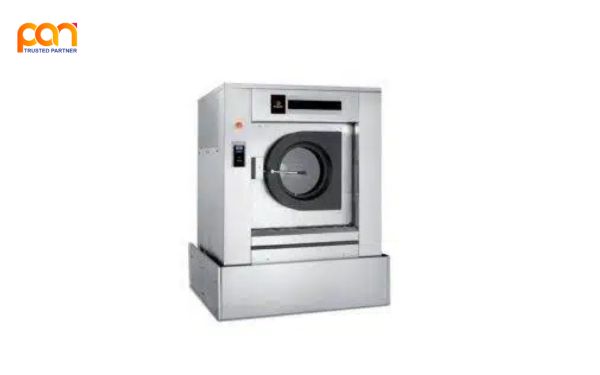
When Should You Invest in an Industrial Washing Machine?
Industrial washing machines are suitable for operations that process laundry regularly and require a controlled washing process. Common applications include:
- Hotels and resorts: processing towels, bed linen, pillowcases, uniforms, and other textiles.
- Restaurants and food-service facilities: processing towels, uniforms, and frequently used textiles.
- Hospitals and healthcare facilities: requiring equipment and laundry processes appropriate for hygiene and infection-control requirements.
- Commercial laundries: processing multiple laundry loads at a high operating frequency.
- Factories and businesses: processing uniforms, workwear, protective clothing, and other textiles generated during operations.
Common Types of Industrial Washing Machines
Different laundry operations require different equipment. Understanding the main equipment categories helps businesses select the right configuration.
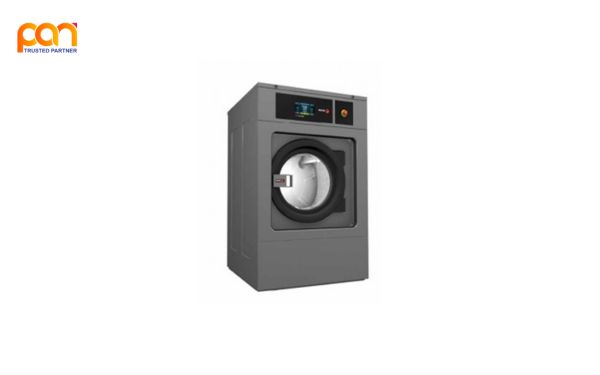
Industrial Washer-Extractors
Washer-extractors are widely used in professional laundries where textiles are processed in individual loads. The machine performs both washing and extraction. Extraction speed and G-force affect the amount of residual moisture remaining in textiles before drying.
PAN's current industrial washer-extractor range includes Fagor models in different capacities, including 11, 14, 18, 25, 35, 45, and 60 kg per load, depending on the model.
Hygienic and Barrier Washing Machines
Hospitals and healthcare facilities may have different laundry-processing requirements from conventional commercial laundries. Barrier washers are designed with doors on opposite sides to support separation between dirty and clean areas during the laundry process.
Both Fagor and IPSO offer equipment designed for environments with higher hygiene requirements. Fagor lists barrier washer capacities from 16 to 100 kg, while IPSO offers hygienic washer-extractors in capacities from 18 to 180 kg, depending on the model.
Continuous Laundry Systems
For large-scale laundries that require continuous processing and high throughput, batch washer-extractors may not be the only option. Continuous laundry systems provide another approach for projects where a continuous processing flow is required.
Therefore, equipment selection should begin with the actual laundry volume and process requirements rather than the nominal capacity of a single machine.
How to Choose the Right Washing Capacity?
Capacity is one of the first factors to determine when purchasing an industrial washing machine. However, choosing the largest available machine is not necessarily the best approach.
The appropriate capacity depends on the amount of laundry to be processed, the number of loads required per day, expected operating hours, and the characteristics of the textiles being processed.
Determine the Laundry Volume
Businesses should estimate laundry volume by day or operating shift rather than relying on a general estimate. Hotels can calculate textile volumes based on rooms, towels, bed linen, and other laundry generated by daily operations. Hospitals should consider laundry volumes by department and the separation of dirty and clean textiles. Commercial laundries should consider customer orders and required delivery schedules.
Calculate the Required Number of Loads
A larger machine is not necessarily more efficient if the actual workload does not require its full capacity. Conversely, a machine that is too small may require more loads and increase the time needed to process the total laundry volume.
Consider Future Expansion
If a laundry facility is expected to expand, future requirements should be considered during system planning. Equipment selection should be coordinated with available space, electrical supply, water supply, drainage, and downstream equipment such as dryers and finishing equipment.
Key Criteria to Check Before Buying an Industrial Washing Machine
Capacity is only one part of the evaluation. Industrial washing machines should also be assessed based on technical and operational requirements.
1. Capacity and Drum Volume
Rated capacity indicates the amount of laundry a machine is designed to process per load under the manufacturer's specified conditions. When comparing models, businesses should consider capacity together with drum volume and loading conditions rather than focusing only on the kilogram rating.
2. Spin Speed and G-Force
Spin speed and G-force influence the amount of residual moisture remaining in textiles after extraction. Better moisture removal can support the following drying process by reducing the amount of moisture that needs to be removed.
Fagor and IPSO offer different extraction configurations, ranging from medium-speed machines to high-spin washer-extractors, depending on the model and application.
3. Programs and Controls
Modern industrial washing machines may offer programmable washing cycles and different control functions. This is particularly relevant when a laundry facility processes different textile groups with different treatment requirements.
For example, selected Fagor models feature programmable controls, USB connectivity, and data-management functions depending on configuration. IPSO also offers touch controls and connectivity options on selected models.
4. Water, Electricity, and Heating Requirements
The infrastructure of the laundry facility should be assessed before selecting the final model. Businesses need to consider electrical supply, water inlet, drainage, and the heating method required by the selected machine.
Equipment should not be purchased before installation requirements are confirmed. Manufacturer technical specifications should be used as the basis for facility preparation and equipment installation.
5. Integration with Downstream Equipment
A washing machine is only one stage of a professional laundry process. After washing and extraction, textiles may move to tumble dryers, ironing equipment, or other finishing equipment.
Therefore, industrial washing equipment should be evaluated as part of the overall laundry process rather than as an isolated machine.
6. Maintenance and Spare Parts
Equipment operating at a high frequency requires an appropriate maintenance plan. When selecting a supplier, businesses should clarify technical support, spare-parts availability, response times, and maintenance procedures.
Should You Buy a New or Used Industrial Washing Machine?
The choice depends on investment budget, equipment condition, expected workload, and the ability to inspect the machine before purchase.
New Industrial Washing Machines
- Clear model specifications and configuration.
- Warranty conditions provided according to the supplier and manufacturer's policies.
- Easier planning for operation and maintenance from the beginning of service.
Used Industrial Washing Machines
- Can reduce the initial investment cost.
- Require careful inspection of the drum, motor, control system, and other relevant components.
- Require verification of origin, operating history, component condition, and warranty terms before purchase.
For used equipment, physical inspection and assessment by a qualified supplier are particularly important. A purchase decision should not be based solely on photographs or a lower price.
Fagor and IPSO – Industrial Laundry Brands Supplied by PAN
PAN TRADING JSC supplies professional laundry equipment from international brands, including Fagor and IPSO. PAN's product range includes industrial washer-extractors, hygienic washing machines, and equipment for different professional laundry applications.
Fagor offers industrial washing machines in different capacities and extraction configurations. The company also provides barrier washer ranges for environments requiring higher levels of hygiene control.
IPSO offers hardmount, softmount, and hygienic washer-extractors in different capacities. Its equipment portfolio covers various laundry environments, from smaller professional operations to industrial and healthcare applications.
Buying an Industrial Washing Machine Should Not Be Based on Price Alone
The initial purchase price is important, but it does not represent the total operating cost of industrial laundry equipment. When comparing machines, businesses should consider capacity, water consumption, energy requirements, cycle time, extraction performance, maintenance requirements, and expected service life.
A lower-priced machine that does not match the actual workload or operating conditions may create additional costs during use. A properly configured machine, on the other hand, can support a more stable laundry process.
A Practical Process for Selecting an Industrial Washing Machine
To reduce the risk of selecting unsuitable equipment, businesses can follow these steps:
- Define the application: hotel, hospital, restaurant, factory, commercial laundry, or industrial laundry facility.
- Measure laundry volume: determine the volume by day, shift, and textile category.
- Determine capacity and quantity: calculate the required processing capacity instead of simply selecting the largest machine.
- Check installation requirements: electrical supply, water, drainage, heating, floor space, and equipment access.
- Review downstream processes: dryers, ironers, and textile-finishing equipment.
- Evaluate the supplier: verify equipment origin, technical specifications, warranty, spare parts, and technical support.
- Request application-based consultation: for laundry projects, provide information about laundry volume and processing requirements so the equipment configuration can be evaluated appropriately.
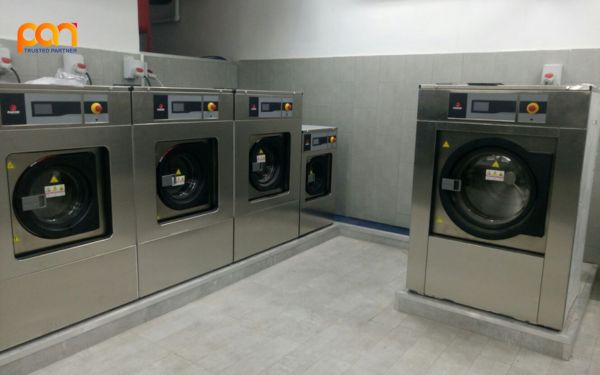
PAN Supplies Industrial Laundry Equipment
PAN TRADING JSC supplies industrial laundry equipment and supports businesses throughout equipment selection, laundry-system planning, implementation, and operation. The website's current product range includes industrial washer-extractors, hygienic washing machines, continuous laundry systems, tumble dryers, ironing equipment, textile-finishing equipment, and industrial laundry chemicals.
PAN also provides laundry facility design consultation, equipment selection, implementation, technology transfer, and technical support according to project requirements.
For projects with specific capacity or laundry-processing requirements, equipment consultation should be based on laundry volume, textile types, facility conditions, and actual operating requirements.
Frequently Asked Questions About Buying Industrial Washing Machines
What capacities are available for industrial washing machines?
Capacity varies significantly by brand and model. PAN's current Fagor washer-extractor range includes models from 11 kg to 60 kg per load, while other specialized equipment can offer larger capacities. The machine category should therefore be identified before comparing capacity.
Should I choose one large industrial washing machine or several smaller machines?
There is no single solution for every laundry facility. The decision depends on laundry volume, required number of loads, textile categories, separation requirements, and future expansion plans.
Does an industrial washing machine need a dryer?
Not every operation has the same requirements. However, in a professional laundry system, washing and drying equipment should be considered together because the amount of residual moisture after extraction directly affects the drying process.
Can hospitals use standard industrial washing machines?
Hospital laundry equipment should be selected according to infection-control requirements and the separation of dirty and clean laundry flows. In environments requiring higher levels of hygiene control, barrier washers are specifically designed for this type of application.
Where should I buy an industrial washing machine?
Businesses should choose a supplier that provides clear technical information, transparent equipment origin, and support for installation, commissioning, maintenance, and spare parts when required.
Conclusion
Buying an industrial washing machine is a decision directly related to laundry-processing capacity and the way a professional laundry operates. Instead of selecting equipment based only on price or maximum capacity, businesses should start with laundry volume, application, extraction requirements, installation conditions, and downstream processes.
For professional laundry projects, evaluating the equipment and process as a complete system from the beginning can help businesses select a configuration that better matches actual operational requirements.
Contact PAN for Consultation
If your business is looking for industrial washing machines or needs advice on selecting equipment suitable for your laundry facility, PAN can support you from equipment selection to industrial laundry solution consultation.
Contact PAN for consultation on industrial laundry equipment and laundry solutions.
Contact Information
PAN TRADING JSC
📍 142 B2 Street, Sala Urban Area, An Khanh Ward, Ho Chi Minh City, Vietnam
📞 (+84) 28 3840 2222 - 0919 302 879
🌐 pantrading.vn | thietbigiatcongnghiep.com
📩 contact@pantrading.vn