Industrial Laundry Dryer Selection Criteria for Commercial Laundries
In an industrial laundry, the dryer handles the textile processing stage after washing and has a direct impact on the overall productivity of the laundry system. An optimized drying cycle not only helps achieve the required level of dryness but also contributes to shorter processing times, efficient energy use, and better control of operating costs.
Therefore, when investing in an industrial laundry dryer, businesses should consider several factors rather than focusing solely on the machine's capacity. The following are important criteria to consider when selecting equipment for a commercial laundry.
1. Dryer Capacity
Capacity is one of the first specifications to determine when selecting an industrial dryer. However, the required dryer capacity should not simply be based on the weight of the textiles before washing.
After washing and water extraction, the weight and moisture content of the textiles will have changed. Therefore, the actual textile load after washing, the required daily processing volume, and the expected operating time should all be considered when selecting the appropriate dryer capacity.
Selecting the right capacity helps prevent overloading and ensures that the equipment is used effectively, contributing to stable productivity throughout the laundry operation.
2. Drying Technology
The way heated air circulates inside the dryer has a significant impact on drying time and energy consumption.
Axial airflow dryer: heated air is directed through the bottom of the drying drum. With this design, the contact area between the heated air and the textiles is limited, which may result in longer drying times and higher operating costs.
Radial airflow dryer: heated air is directed through the body of the drying drum, creating a larger contact area with the textiles. This allows more effective heat transfer, helping reduce drying time and energy consumption during operation.
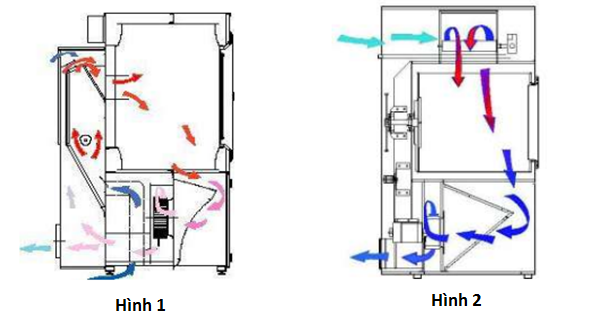
Notes:
- Green arrows: fresh air from outside the machine is drawn in and heated.
- Red arrows: heated air passes through the drying drum and comes into contact with the textiles.
- Blue arrows: air that has passed through the textiles carries moisture out of the dryer.
When comparing different industrial dryer models, businesses should consider how air is distributed inside the drying drum, the level of contact between heated air and textiles, and overall heat-transfer efficiency rather than looking only at the heating capacity.
3. Heating Energy Source
The energy source used for heating is another important factor to consider from the initial investment stage. Depending on the infrastructure and operating conditions of each laundry, industrial dryers can commonly use the following heating sources:
Each energy source has different requirements in terms of infrastructure, investment costs, and operating expenses. Therefore, the choice of heating source should be considered together with the laundry's scale, textile processing volume, and available infrastructure at the installation site.
4. Textile Material
Not all textiles have the same characteristics. Fabric composition affects weight, volume, moisture retention, and the temperature requirements during drying.
- Cotton textiles
- Wool and other natural-fiber textiles
- Synthetic textiles
Because the weight and volume of different fabrics vary, the load factor should also be considered when selecting a dryer. The nominal capacity of the machine alone should not be used without taking into account the actual characteristics of the textiles being processed.
For laundries handling different types of textiles, the ability to adjust drying programs according to each fabric type is also an important consideration.
5. Fire and Explosion Safety
The dryer area is normally exposed to higher temperatures during operation. At the same time, lint generated during laundry operations is another factor that needs to be controlled to ensure the safety of the equipment and operators.
Therefore, safety and fire-warning systems are important criteria when selecting an industrial laundry dryer, particularly for large-capacity laundries and facilities operating continuously.
Some Fagor industrial dryer models can be equipped with an optional fire detection system to help identify abnormal conditions during operation.
Choosing the Right Dryer for Efficient Laundry Operations
An industrial dryer does not operate independently but forms part of the complete textile processing workflow in a commercial laundry. Therefore, equipment selection should be considered in relation to washer capacity, water extraction performance, textile volume, heating energy source, and the finishing processes after drying.
The right choice allows a laundry to achieve a balance between productivity, processing time, energy consumption, and operating costs, while ensuring that the equipment meets its long-term operational requirements.
Contact Information:
PAN TRADING JSC
Hotline: (+84) 28 3840 2222 | 0919 302 879
Address: 142 B2 Street, Sala Urban Area, An Khanh Ward, Ho Chi Minh City
Website: https://pantrading.vn
Website: https://thietbigiatcongnghiep.com
Email: contact@pantrading.vn